
Category: Operations | Reading time: approx. 10 minutes
Most psychiatrists who set out to start a private practice run into the same wall. It isn’t lack of clinical skill, unclear pricing, or fear of marketing. It’s over-building the practice before they see a single patient.
Six months disappear into choosing an EHR. A designer gets hired for a custom website. An LLC gets registered in three states, a fancy logo commissioned, subscriptions purchased for every clinical tool they’ve ever heard of. And they still haven’t seen a paying patient.
Any of that sound familiar? You’re not alone, and you’re not doing anything wrong. Every physician has been trained to prepare exhaustively before acting. That instinct serves patients well in a clinical setting. It costs a lot of money in a business setting.
There’s a different approach, and it’s the framework I teach every psychiatrist in Dream Practice Academy: the minimum viable practice. Applied consistently, it has gotten psychiatrists to their first paying cash-pay patient in weeks rather than months.
What Is a Minimum Viable Practice?
“Minimum viable product” is a term borrowed from the startup world. It describes the leanest possible version of a business: the smallest set of components needed to actually deliver value to a customer, so you can start learning what works before committing to a fully built-out version.
Applied to psychiatry, a minimum viable practice is the smallest configuration required to legally, safely, and professionally see your first cash-pay patient. That’s it. Not the practice you’ll have in year three. Not the practice other psychiatrists are posting about on Instagram. Just the one you need this month.
Launching lean is not a compromise. It’s a strategy. You start with the essentials, see real patients, and let the actual work of running a practice tell you what to add next, rather than trying to predict everything from a spreadsheet.
Nearly every optimization you can imagine (fancier tools, deeper automation, additional revenue streams, more sophisticated marketing) becomes more useful, and more affordable, after you have paying patients. Not before.
What You Actually Need (And What Can Wait)
Here is an honest working list of what a psychiatrist genuinely needs to start seeing cash-pay patients, and what belongs on a “later” list.
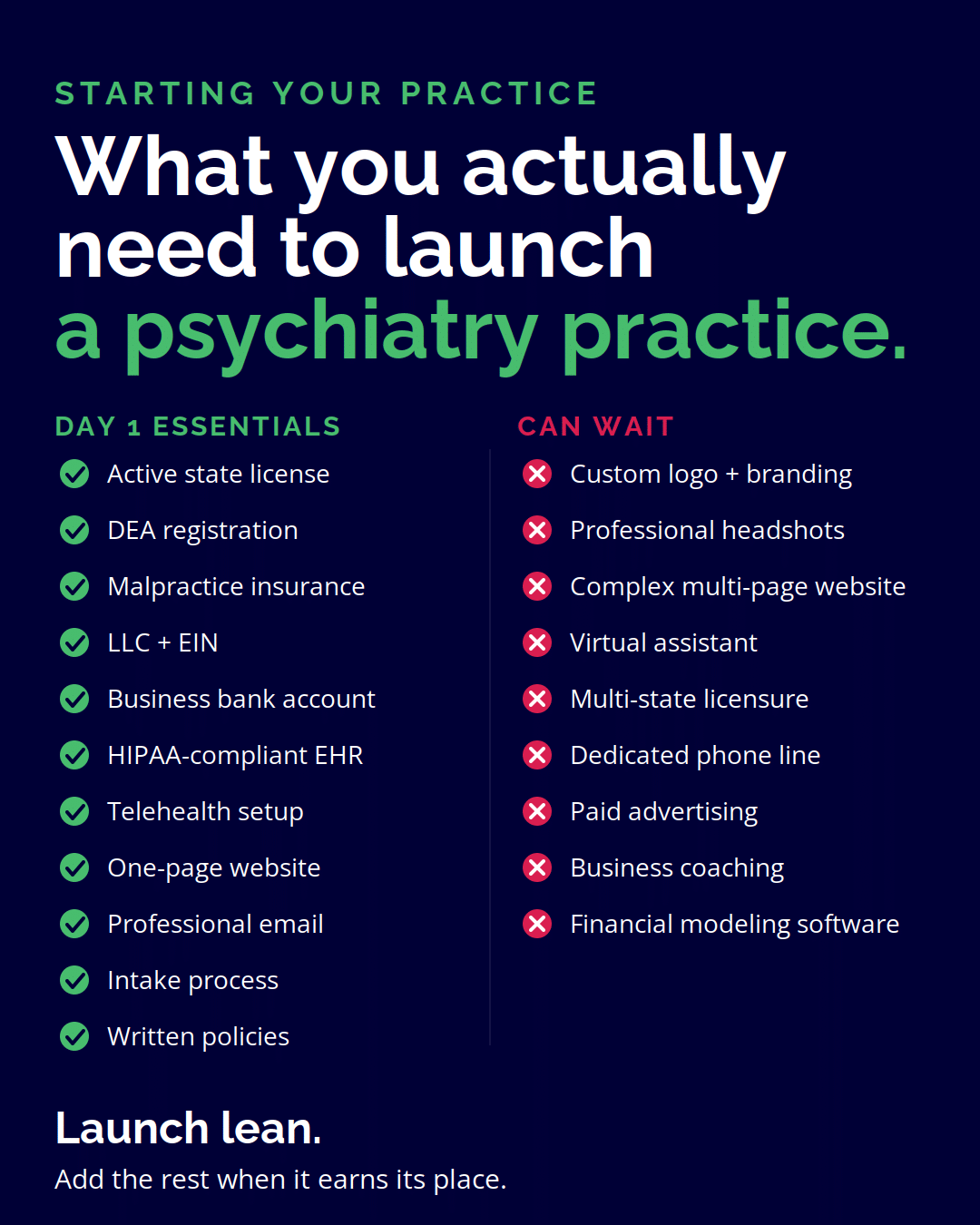
What you need on day one
- An active state license in the state(s) where you want to practice
- An active DEA registration (if you’re prescribing controlled substances)
- Malpractice insurance — telepsychiatry-appropriate, with your practice details on the policy
- A business entity (usually a single-member LLC in your home state) and an EIN
- A business bank account, separate from personal
- A HIPAA-compliant EHR that also handles scheduling and billing (SimplePractice, Practice Better, Osmind, or similar)
- A telehealth solution (many EHRs include this)
- A simple one-page website with your name, credentials, offering, fee, and a way to book a consultation
- A professional email address on your own domain
- A clear intake process for new patients
- Written policies for informed consent, cancellations, no-shows, and refunds
Nothing else on day one is truly required. That’s the whole list.
What can absolutely wait
- A custom-designed logo and brand identity
- A photographer for headshots
- A complex multi-page website with a blog
- A virtual assistant (until you have enough patients to justify one)
- Multi-state licensure (start with one state)
- A dedicated business phone line (most EHRs handle patient messaging)
- Paid advertising
- Business coaching, unless you have a specific clear reason for it
- Fancy financial modeling software (a spreadsheet works)
Every item on the second list is legitimate at some point. None of them is legitimate before you have paying patients. Over-building infrastructure for a practice that doesn’t yet exist is one of the most expensive habits in medicine right now.
The Step-by-Step Setup (In the Right Order)
Order matters here, because many psychiatrists get stuck trying to do everything at once. Here is the sequence I recommend, with rough time estimates for each phase.
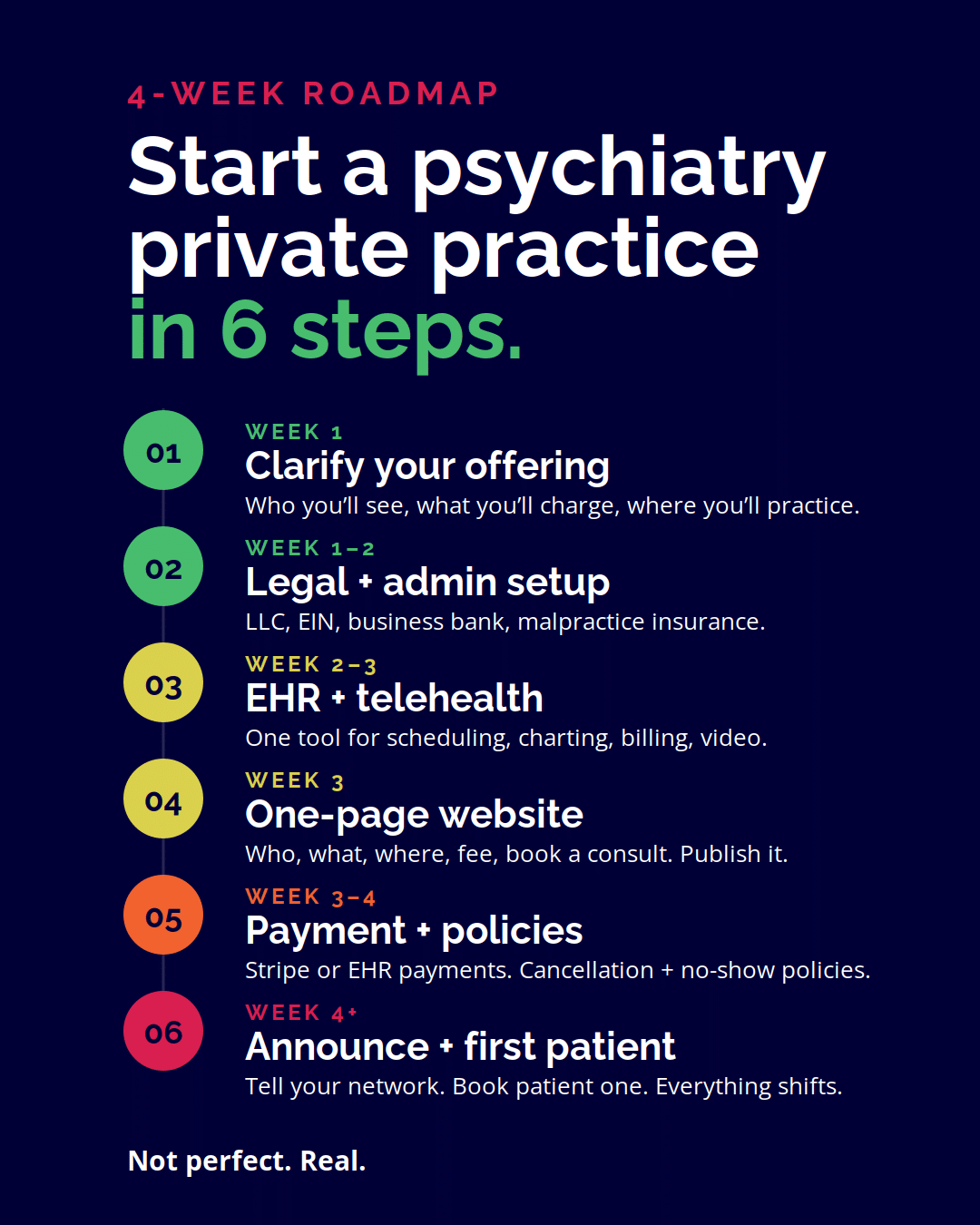
Step 1: Get clear on your offering (Week 1)
Before registering a single business entity, answer these questions in writing: what type of patients do you want to see, what services will you offer, what will you charge for an evaluation and for follow-ups, and what state(s) will you practice in?
These answers do not need to be perfect. They need to be clear enough to make the next decisions. Refinement can come later. What can’t come later: registering an LLC and setting up an EHR before knowing what you’re offering. Skip this step and you’ll redo half the setup.
Step 2: Legal and administrative setup (Week 1–2)
Register your LLC in your home state, apply for your EIN (free through the IRS website), open a business bank account, and secure malpractice insurance appropriate to your setup. Transitioning out of an employed position? Review your employment contract for non-compete and non-solicitation clauses before taking other visible steps.
Expected costs: LLC filing runs $100–$300 depending on state. Malpractice for telepsychiatry costs $100–$300 per month. Bank accounts are usually free.
Step 3: EHR and telehealth setup (Week 2–3)
Choose one EHR that handles scheduling, telehealth, charting, and patient billing. Set up your calendar, fee structure, intake forms, consent documents, and basic templates. This is the single most important tool in your practice. Don’t over-optimize the choice, but do commit to actually setting it up rather than just paying for a subscription.
Expected cost: $50–$200/month for most solo-practice EHRs.
Step 4: Web presence (Week 3)
You need a simple one-page website. Not a beautiful custom site. Just one page that clearly states who you are, what you offer, where you’re licensed, what you charge, and how to book a consultation. Squarespace, Wix, or a basic WordPress template are all fine. Buy your domain, connect it to a professional email, and publish.
Expected cost: $20–$50/month for the site plus domain and email. One weekend of work.
Step 5: Payment and admin (Week 3–4)
Connect a payment processor (Stripe, Square, or your EHR’s built-in payment system). Set up your bookkeeping. A simple spreadsheet is fine to start. Define your cancellation policy, no-show policy, and refund policy in writing, then add them to your intake documents.
Step 6: Announce and take your first patient (Week 4+)
Tell people you’re open for consultations. Start with your existing network: former colleagues, therapists you know, primary care physicians, mentors. Post on LinkedIn if that fits your style. Reach out to two or three therapist practices in your area with a brief introduction.
Then, and this is the part where many psychiatrists get stuck: book the first patient. Not the fifth. Not the tenth. Just the first. Once you see your first paying patient, everything shifts.
If you want the deeper mechanics of what to actually put on the website, how to structure your fees, and how to communicate the value of a cash-pay model, How to Build a Cash-Pay Psychiatry Practice is the most thorough resource on this site.
Common Mistakes That Delay Your Launch
Understanding the minimum viable practice concept in theory doesn’t protect you from the same handful of traps when you actually try to launch. Here are the ones I see most often, and how to avoid them.
The EHR mistake: choosing by feature comparison instead of usability
You’ll spend more time inside your EHR than any other tool in your practice. If it makes you cringe every time you open it, no set of features is going to compensate. Pick one that feels intuitive, has strong customer support, and is priced sustainably. Migration is possible later if you outgrow it. Very few practices actually do.
The pricing mistake: undercharging to feel safe
Nearly every new private practice psychiatrist under-prices at launch by 30–50%. Their reasoning tends to sound like this: I don’t have experience running a practice yet, so I should charge less until I do. That reasoning is backwards. You aren’t selling your business experience. You’re selling your clinical care. If your clinical care is good, price it accordingly. Under-pricing attracts patients who are shopping on cost, drains your energy at the exact moment you need momentum, and makes raising fees later significantly harder.
The readiness mistake: waiting until everything feels ready
There is no version of “ready” that will feel fully confident before you see your first patient. Confidence comes from the doing. Every psychiatrist I’ve worked with who launched successfully will tell you they felt roughly 60% ready when they took the first patient. The other 40% got learned in the actual work.
The scope mistake: building for the practice you want in year three
Your year-three practice is not the practice you need to launch. What you need to launch is the leanest possible version that lets you legally and professionally see a patient. Everything else gets added when it earns its place, not when you imagine it might.
The announcement mistake: never actually telling anyone
It’s surprising how many psychiatrists set up an entire practice and never actually tell anyone they’re open. Your first patients will almost always come through your existing network. Without an announcement, they can’t refer.
The First 30 Days: What Actually Happens
Once you launch, the first 30 days feel very different from what most psychiatrists expect. Not necessarily harder or easier, just different in ways that are worth knowing about in advance.
Week 1: The email inbox
You’ll get consultation inquiries. Some will be perfectly aligned patients you’re excited to see. Others will be looking for something outside your scope. A few will disappear after the first email. This is normal. Your job in week 1 is to respond promptly, screen for fit, and book the ones that work.
Week 2: The first patient
Your first patient is a milestone. Expect to feel more nervous than you have in years, not because of the clinical work but because you’re practicing in a completely new structure. That nervousness fades after two or three visits. Clinical work is the part you’ve been trained for. Business structure around it is the part that’s new.
Weeks 3–4: The learning curve
You’ll discover the things you didn’t think through fully: an ambiguous intake question, a scheduling conflict you didn’t anticipate, a technical issue with a receipt or superbill. This is how you learn what your practice actually needs. Every issue in the first month is a signal, not a failure. Adjust the system and move on.
By the end of month one, most psychiatrists in my program are seeing 2 to 5 patients per week. That’s a strong start. Practices that appear to fill overnight usually took years to make it look sudden.
What to Do Next
Been sitting on the idea of a private practice for months (or years)? Here’s what to do this week:
- Write down your answers to the four Step 1 questions: who you want to see, what you’ll offer, what you’ll charge, and where you’ll practice. Don’t skip this.
- Identify the one item on the Day 1 list you can move on immediately. For most psychiatrists, that’s LLC registration or malpractice — both of which can be done in an afternoon.
- If you want a personalized look at what your specific launch would look like, book a free consultation call.
And if you want to go deeper on the practice structure that makes this framework actually work, How to Transition From Insurance to a Cash-Pay Practice walks through the specific transition path many psychiatrists use.
You don’t need a perfect practice. You need a real one. Everything else gets built as you go.

Ready for your next step?
Want a clear, step-by-step plan for building your dream private practice (without the overwhelm)? Grab the free Private Practice Roadmap by answering a few quick questions below. It’ll help you get clarity on your next best steps, avoid common early mistakes, and start creating a practice that actually fits your life and values.


Leave a Reply