How Dr. UK Quang-Dang built a hybrid, cash-pay geriatric psychiatry practice around her family, her patients, and the life she wanted — in five months.
DPA Member Case Study | Reading time: approx. 9 minutes
For six years, Uyen-Khanh “UK” Quang-Dang, MD, MS did what most institutionally employed psychiatrists do: she showed up. She saw the patients scheduled for her. She provided the best care she could within the structure the system had built. And she did it well.
On many days, that meant seeing fifteen patients. During the height of COVID, seventeen or eighteen. She started referring to herself, only half-jokingly, as “a soldier in the battle against COVID.” She said it the way a lot of physicians said things during that period: with a kind of weary pride, and with the quiet understanding that something in the arrangement wasn’t sustainable.
UK is a geriatric psychiatrist. She trained at Harvard for undergrad and at the Harvard School of Public Health. She earned her MD at New York Medical College. She completed psychiatry residency and a geriatric psychiatry fellowship at UCSF. Her patients are complex: elderly adults with overlapping neurological, medical, and psychiatric conditions, patients whose care requires long visits, careful thinking, and the kind of clinical depth that a fifteen-minute slot cannot support.
In her own words, describing what her care felt like inside that structure:
“I saw myself as just doing not the bare minimum, but between mediocre and the bare minimum. Which I still think was probably pretty good, because I can’t help but try really hard and overdo. But I saw myself as not doing the most I could for each patient.”
Reading that quote and knowing UK’s training, you already know why she couldn’t stay there forever.
A Pause, a Crisis, and the Moment Everything Changed
UK stepped away from medicine to raise her daughter, who is now four. The plan was always to come back to patient care, but the timeline was open. Then, in 2024, a series of things happened at once.
Her father, who has lived with Parkinson’s disease for over fifteen years, experienced a cervical spine hemorrhage: a stroke in the neck. He briefly became quadriplegic. Within three weeks, he moved into UK’s home, and she became his primary caregiver, essentially overnight.
She describes the physical toll as significant. The emotional toll was harder. Her father was, in her words, her only patient during that period. He wasn’t interested in that arrangement, and she was aware, painfully, that she was probably too invested. She was watching her father recover from something that could have been fatal, and she was doing it in the role of caregiver rather than psychiatrist.
Several months in, he began to walk on his own again. He could shower on his own. The immediate crisis eased. And the people closest to UK, her husband, her brother, close friends, started saying something she hadn’t been able to hear before.
“I know you’re really busy. But your dad has become your only focus.”
What UK realized in that moment was that she had a tremendous amount of geriatric psychiatry energy to give, and no clinical place to put it. Her father was her only patient. She wanted, in her own light-hearted phrasing, patients who actually wanted to see her and who would pay her.
She had already, a year earlier, found the beginning of a path forward.
The Google Search That Started It (And the 2009 Email Neither of Us Remembered)
In 2024, when her daughter first went to daycare, UK Googled a private practice question. The question was: how do you say no to patients in a way that’s kind? She had already identified what she believed would be her biggest obstacle in private practice, not the logistics of starting a business, but the emotional weight of setting boundaries with the patients and families she couldn’t take on.
Elana Miller’s face came up in her search results. UK recognized her immediately, and then confused herself, because she was sure they’d already met.
As she and Elana would later piece together on-camera, they had exchanged emails as early as 2009, when UK was cheering Elana on before her Step 2 CK exam. Then again in 2013, when UK sent a fan letter about Elana’s blog. Then not again for eleven years, until UK saw Elana’s picture on a search result and thought: “Oh my God. I know her.”
Six to eight months later, UK joined Dream Practice Academy. It was March 2025.
What DPA Actually Did For UK (In Real Numbers)
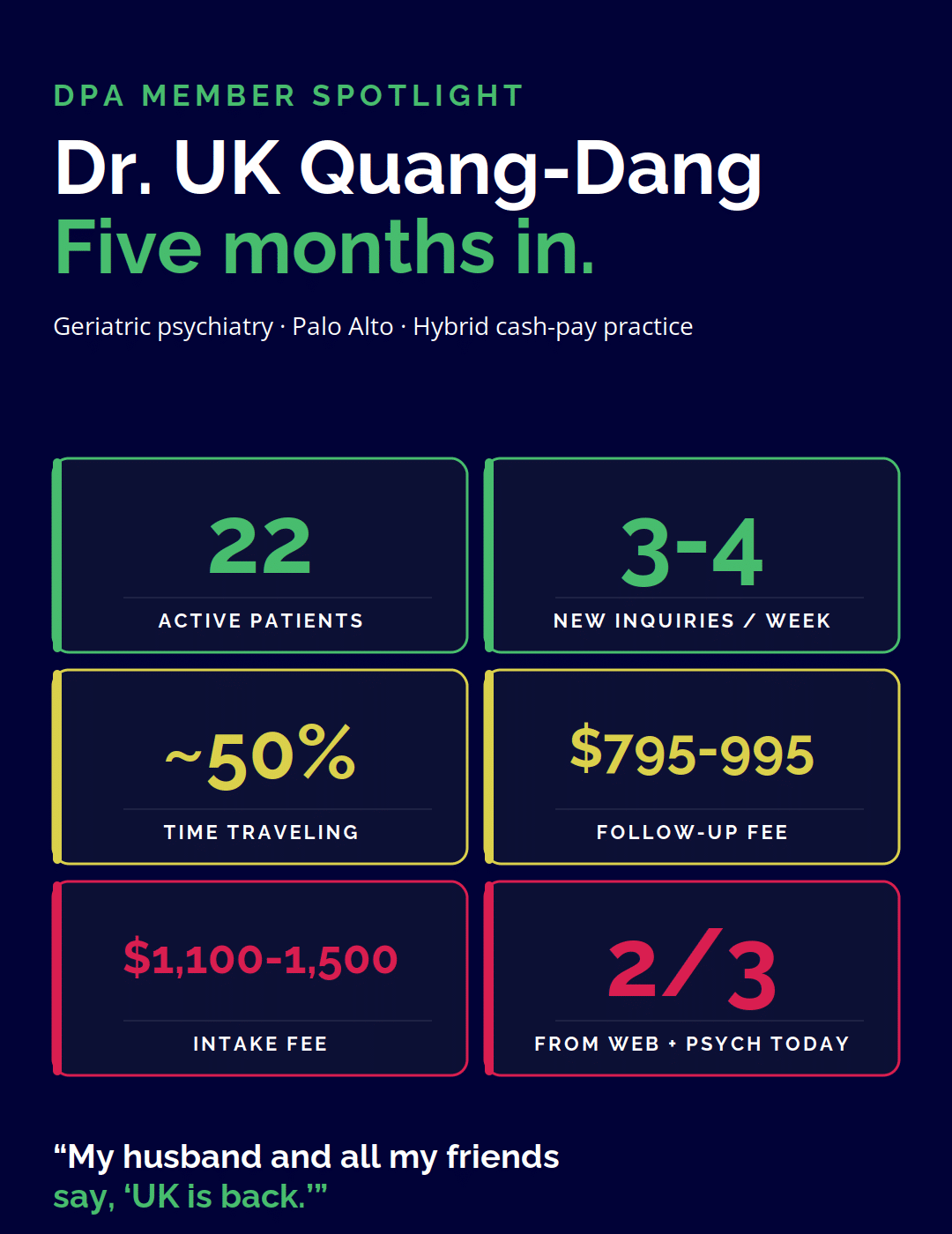
Case study results are usually where things get vague. That won’t happen here. UK is a geriatric psychiatrist with training that requires nuance and time, and her practice is small by design. Here is where she is, five months into actively growing her practice:
22 active patients at the time of this interview
3–4 new patient inquiries per week (as of the interview date)
~50% of the past five months spent traveling, with growth continuing anyway
$795–$995 per 60-minute follow-up visit
$1,100–$1,500 for a 60–90-minute new patient intake
2/3 of new inquiries now come through her website and Psychology Today
UK sees roughly half of her patients over Zoom. She sees one-quarter in person in her Palo Alto office. She sees the remaining quarter in patients’ homes, nursing homes, and assisted living facilities. This hybrid structure exists because it’s what her patient population actually needs, and because it’s the practice she was able to design when no one else was telling her how to structure her day.
She is a mother to a four-year-old. She is still helping care for her recovering father. She works part-time, in the fullest sense of the phrase. She practices integrative psychiatry, which allows her to treat elderly patients who cannot tolerate standard-dose SSRIs (her example: an 81-year-old patient for whom 6.25 mg of Sertraline caused immediate diarrhea; UK switched her to SAMe, which the patient tolerated well and titrated successfully). She is doing the work she trained to do, on the schedule her life actually allows.
She is also, according to her husband and her closest friends, back.
“My husband and all my friends say, ‘UK is back.’ I was kind of not there for like a year or two. I wake up thinking about my patients. Not in a bad way. I’m totally brainstorming.”
What Actually Made the Difference
Beyond the numbers, UK identified specific elements of Dream Practice Academy that changed the trajectory of her practice. Each of these came up unprompted during the interview.
The website, and what it means to see yourself on the page
Building the website was, in UK’s words, the most amazing part of the entire program. She filled out what she called “the combination of my college essay, medical school essay, residency essay, and my personal journal”, a 10 to 15-page questionnaire covering who she is, what she values, and how she practices. Her assigned marketing coach, Corey Dysick, interviewed her for over an hour on top of that, digging into the parts he’d marked up in her responses.
Then he wrote her website.
“When I read my About Me section, I teared up twice.”
Being seen accurately in writing, without oversharing and without diluting what matters, is not a small thing. For a physician who described herself as a good writer but who found writing about herself difficult, having a website that captured her actual clinical voice made the launch feel real. Every marketing tactic that followed was easier because the foundation underneath it was true to who she was.
The mindset shift around fees
UK started with a follow-up fee of $600 for 45 minutes. She now charges $795 to $895 for a 60-minute follow-up (with $995 as an option for particularly complex work), and $1,100 to $1,500 for intakes.
Her language around that change is worth paying attention to. She initially described her fees as “rates that you feel that you deserve.” Then she paused mid-sentence and corrected herself. Elana had trained the group to describe it differently.
“Actually, the idea of the rates that you deserve, that needs to be new verbiage. And figuring out what that is.”
Learning to be confident about her fees, and to hold that confidence in front of patients, families, and herself, is something UK now brings to her colleagues. She has helped peers who never joined the program simply by translating what she’s learned. Her practice is not the only place where the mindset work is having downstream effects.
The systems, without the research overwhelm
UK is candid about not being naturally drawn to the business side, the marketing side, or the logistical side of running a practice. She wanted to focus on clinical work, and DPA let her do that. She named specifically the checklists she referred to “100 times,” the PracticeQ setup done for her, the Heidi AI integration, and the guidance on Psychology Today profile setup.
“I know I’m working with the best systems out there because of you guys. So I’m not going, ‘Oh, is there something better out there? Is there a better program, a better AI, a better whatever?’ I just need to spend time with it.”
For a physician who values her time as much as UK does, being spared the research burden is not a nice-to-have. It is the reason she was able to start seeing patients quickly, and it is the reason her clinical hours have stayed protected as her practice has grown.
The clinical up-leveling
DPA is not just a business program. UK was clear about this. It also up-levels the clinical work itself, particularly through the integrative psychiatry training. Her geriatric patients, who often cannot tolerate standard psychiatric medications, benefit directly from her expanded toolkit. She has signed up for the upcoming Auvelity training, is already prescribing SAMe with success, and treats the integrative side as inseparable from the business side.
“Integrative psychiatry really empowers you to treat so many more people and just make you a more effective psychiatrist.”
A note from Elana
There are a few things I want to say about UK’s story, because they matter beyond her individual practice.
First: UK’s outcome, five months in, is not exceptional in the way that word sometimes suggests. It is exceptional in the sense that it required her to make a specific set of choices in a specific order. It is not exceptional in the sense that only she could have done it. Psychiatrists and PMHNPs in Dream Practice Academy are producing results in the same range consistently, in urban markets and smaller ones, in geriatric psychiatry and general psychiatry and integrative work, and across a wide range of life circumstances.
Second, and this is what UK named toward the end of our conversation: I think it is the most important thing anyone considering this kind of transition can hear. She said she used to think of herself, in the system, as helping a large population of people survive. That framing carried real weight for her, and it was true. But she also said this:
“My own mental health was definitely taking a hit. Now that I’m practicing psychiatry the way that I want, I’m not thinking in those huge population numbers anymore. Because my quality of life and the quality of my thinking, my potential, is just so much greater because I’m able to think more deeply about my patients.”
Seeing many patients briefly vs. seeing fewer patients deeply is not a moral choice. It is a structural one. UK is treating the same complex geriatric population she always treated. She is simply treating them the way her training prepared her to.
Third, and this is what her husband and friends noticed without her having to say a word: she is back. Not back to work. Back as herself. Awake, engaged, thinking about her cases at breakfast because she’s excited to, not because she’s worried.
Building a private practice is not the point. Building a life you can be present in, and practicing medicine the way you were trained to practice it, is the point. The practice is the container that makes that possible.
If you are somewhere near where UK was in 2024, tired, unsure of the mechanics, quietly aware that something has to change, I want you to know that the path she took is available to you too. She used to be a good soldier in a system that was slowly grinding her down. She is now the physician her patients need, on the schedule her family needs, with the income her expertise commands.
If any of that resonates, that’s the signal I’d listen to.
What to Do Next
If UK’s story resonated, and you’re thinking about whether this kind of transition is possible for you, here are three ways to take a next step:
- If you’re at the earliest stage of considering private practice: Grab the free Private Practice Roadmap below. It will help you get clarity on where you are and what your next best step is.
- If you’re ready to see whether Dream Practice Academy could be the right fit for your situation: Book a free consultation call with the team. We will look at your specific circumstances and tell you honestly whether the program is right for you. Book here
- If you want to hear the full story in UK’s own words: Watch the interview above. She is warm, thoughtful, and unusually candid about what actually changed for her.
For a deeper look at what a well-designed cash-pay practice actually involves to build, How To Build A Cash-Pay Psychiatry Practice In 2023 (Better Than Reddit) is the most complete resource on this site.
Ready for your next step?
Want a clear, step-by-step plan for building your dream private practice (without the overwhelm)? Grab the free Private Practice Roadmap by answering a few quick questions below. It’ll help you get clarity on your next best steps, avoid common early mistakes, and start creating a practice that actually fits your life and values.


Leave a Reply